Etiqueta: bonobos
Kanzi, el bonobo que vocalizaba para comunicarse con humanos

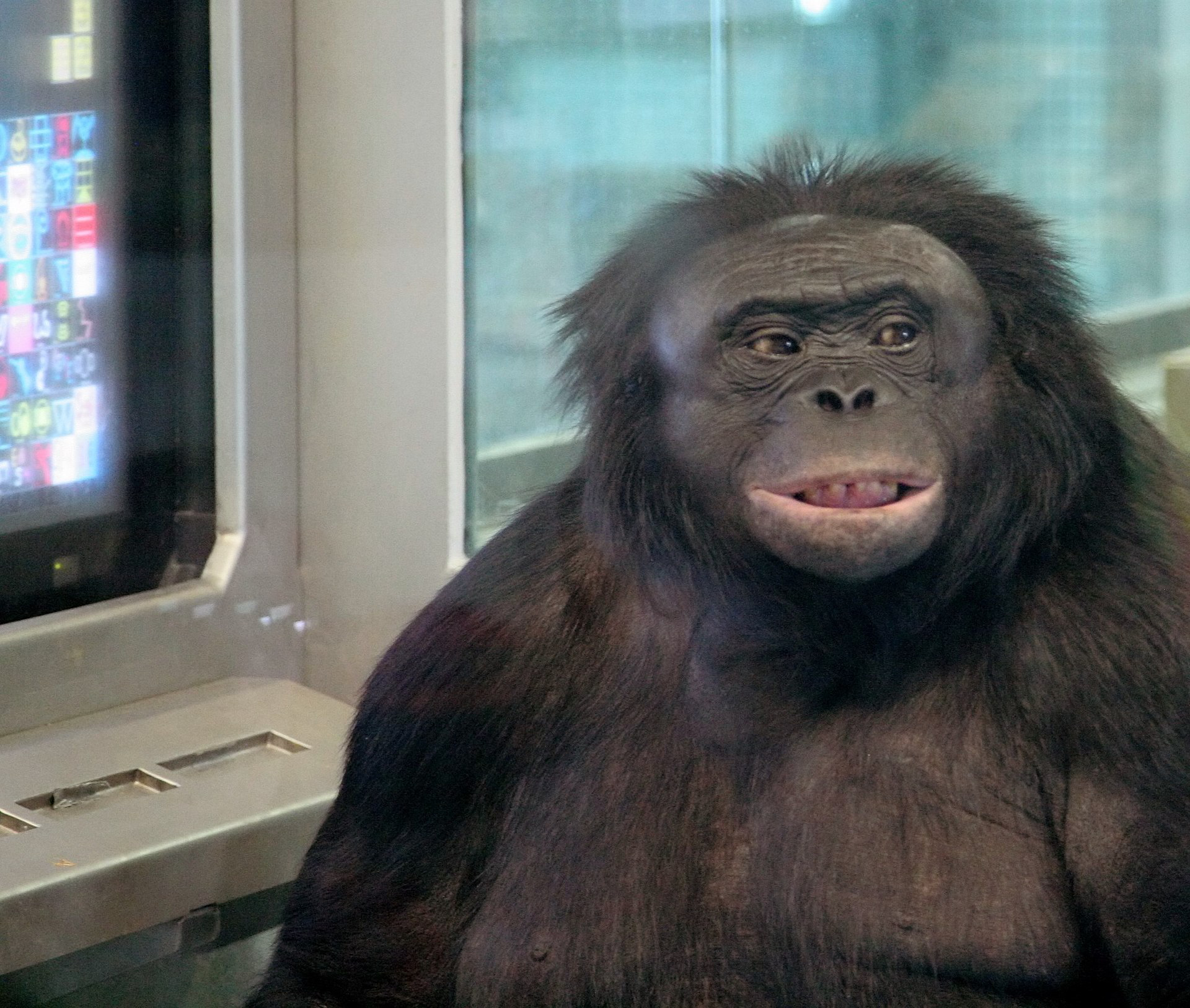
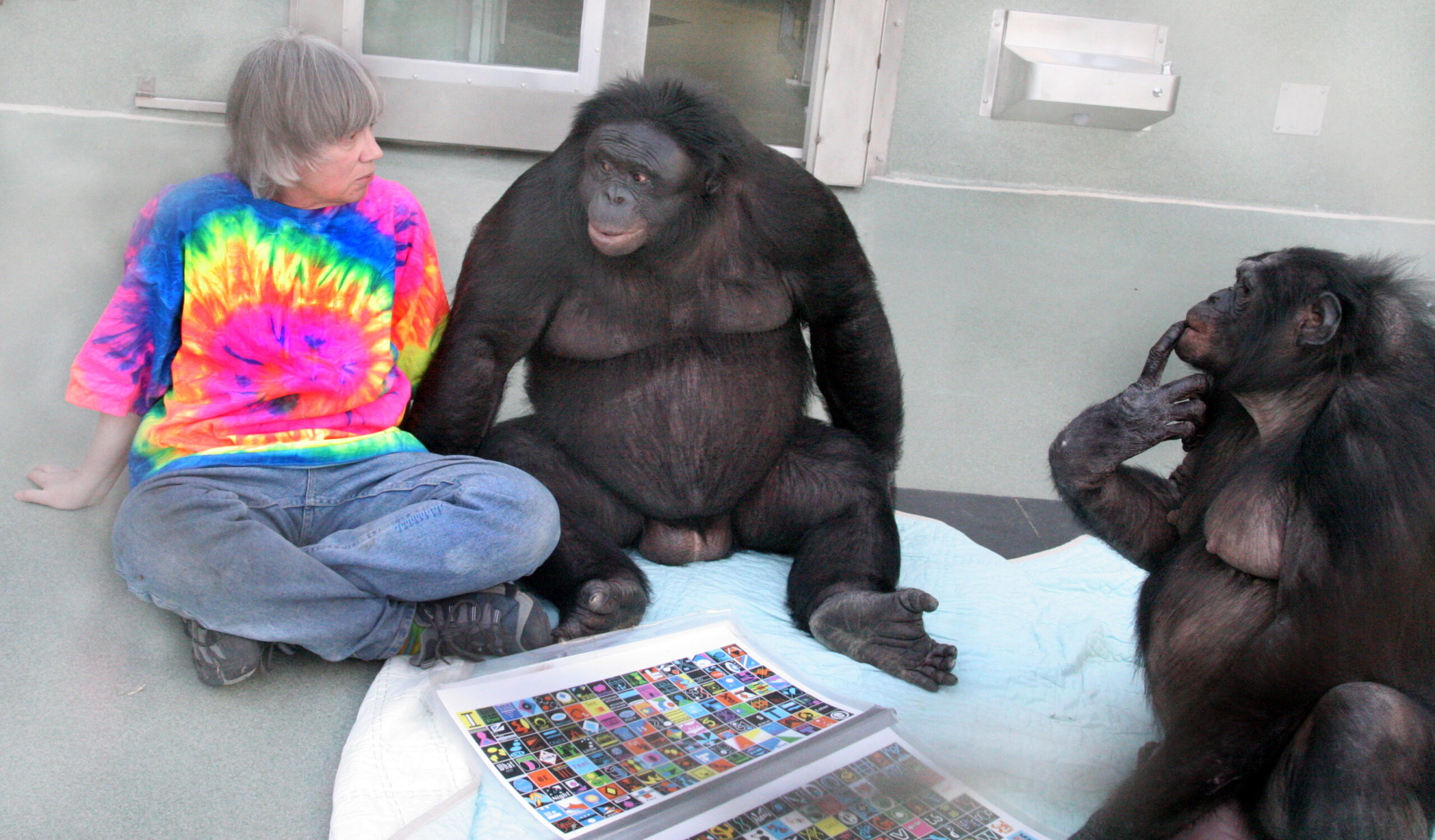
Kanzi, el bonobo que trabajó con Sue Savage-Rumbaugh y que vocalizaba para comunicarse y entender mensajes complejos. →
Bonobos and Human Language: According to ‘Science’, We’re Not That Special

Somewhere deep in the forests of the Democratic Republic of the Congo lives a species of primate called the bonobo, a close cousin of ours that we’ve collectively ignored in favour of the more macho chimpanzee. Big mistake. Bonobos are, quite frankly, our evolutionary embarrassment, the eloquent critique of everything we’ve messed up.
They live south of the Congo River and, unlike their chimpanzee relatives (known for solving disputes with a well-placed punch and a smirk of moral superiority), bonobos prefer peace, consensus, and a whole lot of mutual rubbing to resolve conflicts. And when I say “a lot,” I mean enough to make a soap opera blush.
You can tell them apart easily. When you see a bonobo and a chimpanzee side by side, the bonobo’s the one that looks like it hasn’t slept. Or, as biologists put it, “the less intimidating one.”
You can find the original article in Spanish here.
Their societies are matriarchal: females, though smaller, band together to maintain order, proof that the so-called “male supremacy” of our species is little more than a tantrum that got out of hand. If you want to understand how cooperation and unashamed promiscuity can be the keys to social harmony, forget your self-help books and watch a few bonobo videos. You’ll learn more about conflict resolution than from any corporate leadership seminar.
For the record, yes, bonobos might have an elaborate social life and a proto-language, but they still can’t cook a decent paella. The Valencians among us can relax; we still have that edge.
When the Apes Start Talking Back
Here’s where it gets properly interesting and mildly humiliating for us. A new paper published in Science by Mélissa Berthet, Martin Surbeck, and Simon Townsend suggests that bonobos might possess something very close to the foundation of human language. They’re capable of “compositionality”, the ability to combine simple sounds into complex, meaningful sequences; basically, the same mental trick we use to build words and sentences.
Compositionality is the ability to combine units of meaning (like words or syllables) to create something new whose sense depends on both the parts and how they’re organized. In its simplest form, the trivial one, the meaning of a phrase can be directly understood from the words themselves: “black dog” means exactly that, a dog that’s black. But there’s also a more advanced, non-trivial kind, where meaning shifts in more complex ways, as in “bad dancer,” where one word profoundly alters the other. Understanding “bad dancer” requires a fair bit of cognitive juggling: there are at least two dancers in play, and one of them isn’t visible. Until now, we thought humans were the only species able to use that mental structure. According to this study, the bonobos have just applied for membership.
Until recently, this was our golden trophy: humans were the only species thought capable of structuring meaning in this way. Turns out we may have just been loud about it.
The researchers recorded hundreds of hours of wild bonobo vocalisations: over 700 recordings, each meticulously analysed across hundreds of behavioural and contextual variables. Then they applied a computational technique usually reserved for linguistics and AI: distributional semantics, mapping how different sounds relate to meaning depending on the situation. In simpler terms: they built a dictionary of what bonobos might be saying.
Distributional semantics is a way of figuring out what words mean by looking at how they’re used. Instead of asking a dictionary, it asks: which words tend to hang out together? The basic idea is that meaning can be inferred from context: if “coffee” often appears near “cup,” “mug,” and “morning,” you can safely assume it’s something people drink. In computational linguistics, this becomes math: algorithms turn words into numbers and measure how similar their usage patterns are across thousands of sentences. The result is a kind of map of meaning, built entirely from how words behave in real life. In the bonobo study, scientists borrowed this technique to analyse vocalisations, creating a semantic “map” of their calls, a way to see whether certain sounds consistently appear in the same social or environmental contexts, hinting that they carry specific meanings.
The Results
The team identified seven main call types that the bonobos combined in structured ways. Some combinations were predictable, like “food now” or “danger there.” But others showed something deeper: meanings that weren’t just the sum of their parts. That’s where compositionality gets exciting and uncomfortable. It means bonobos don’t just grunt randomly; they build meaning through combination.
In at least three of the structures, the patterns were complex enough for the researchers to speak, cautiously but seriously, of a kind of proto-grammar. Not Shakespeare, sure, but it’s a start.
No one’s suggesting these apes are about to publish War and Peace, or even tweet, but their communication seems more structured, flexible, and meaning-rich than we ever imagined. And that shakes the story we like to tell about ourselves.
The implications are deliciously humbling: the ability to combine sounds meaningfully might predate Homo sapiens by millions of years. It could go all the way back to our last common ancestor with bonobos and chimpanzees; somewhere between seven and thirteen million years ago. In other words, language didn’t start with us. It evolved from something older, shared, and much less flattering to our ego.
Other Species Talk Too, Just Not Like This
We’re not the only species that communicates, obviously. Whales compose entire symphonies beneath the waves, dolphins call each other by name, and parrots can mimic human speech with eerie precision. But none of them seem to have this knack for mixing and matching sounds to make entirely new meanings.
That ability (to combine symbols into infinite possibilities) is the difference between communication and language. And yet, every new discovery seems to show that the gap between “their noise” and “our words” is a lot thinner than our vanity allows.
The Blurred Line Between “Us” and “Them”
The authors of the study are careful not to overstate their claims. They can’t yet tell what every bonobo call means, only infer it from context. It’s also not a full-blown language: no grammar rules, no fixed vocabulary, no poetry slams. Still, the structure they observed is undeniably flexible, adaptive, and intentional; and if that doesn’t sound like us, what does?
So maybe the line between human language and animal communication isn’t a wall. Maybe it’s a slope. Language, then, isn’t an invention that appeared out of nowhere but a continuation of something ancient.
It’s funny, really. While we humans argue online about whether emojis count as words, bonobos have spent generations combining sounds with more coherence than most Twitter threads. They don’t have social media. And, incidentally, they have much more sex. Draw your own conclusions.
What It Means for Us
Beyond the science, the real question is unsettling: if bonobos can string together meaningful sound patterns, what actually separates us from them? The easy answers (culture, writing, or anti-dandruff shampoo) are starting to feel flimsy. Strip away the gadgets, and we’re still just primates trying to make sense of each other through sounds, gestures, and the occasional awkward silence.
Bonobos use vocalisations to coordinate, soothe, warn, and connect. Other species do similar things, but bonobos do it with layers of context and abstraction that look a lot like our own. The difference isn’t categorical: it’s evolutionary. A matter of degree, not kind.
Which means language didn’t just appear with humans. It grew. Slowly. Patiently. And, apparently, quite erotically.
A Lesson in Humility
What I love most about this study is what it says between the lines. The bonobos’ “uhs” and “ahs” aren’t just jungle background noise: they’re echoes of the same impulse that led us to build alphabets, write novels, and argue in comment sections.
Maybe language isn’t what makes us human. Maybe it’s what makes us animal.
So while we continue inventing ever more complicated ways to misunderstand each other on WhatsApp, the bonobos will keep communicating, efficiently, elegantly, and with enviable physical enthusiasm.
The joke’s on us.
El País: Los chimpancés y los bonobos recuerdan a sus amigos décadas después de estar separados.