Es maravilloso pensar
Es maravilloso pensar que un hablante de japonés menciona la victoria de Bill Clinton en las elecciones presidenciales diga algo así como “We have very interested in Clinton’s erection”.
Esto lo dijo Masaaki Yamanashi, lingüista, en 1992 y me meo.
Why is public speaking so exhausting?
One easy way to understand speech sounds is to track a glob of air through the vocal tract into the world, starting in the lungs. When we talk, we depart from our usual rhythmic breathing and take in quick breaths of air, then release them steadily, using the muscles of the ribs to counteract the elastic recoil force of the lungs. (If we did not, our speech would sound like the pathetic whine of a released balloon.) Syntax overrides carbon dioxide: we suppress the delicately tuned feedback loop that controls our breathing rate to regulate oxygen intake, and instead we time our exhalations to the length of the phrase or sentence we intend to utter. This can lead to mild hyperventilation or hypoxia, which is why public speaking is so exhausting and why it is difficult to carry on a conversation with a jogging partner.
Steven Pinker
Stand Alone Romanian
Por si te interesa, aquí la mejor gramática del rumano que hay online (en inglés).
La lengua de signos nicaragüense y el ramen que me quitó las ganas de follar

La Lengua de Signos Nicaragüense (LSN) es un ejemplo fascinante de la capacidad innata del cerebro para crear sistemas de comunicación. Surgida en la década de 1970, cuando niños sordos de Nicaragua, previamente aislados y sin un sistema formal de comunicación, comenzaron a asistir al Centro de Educación Especial Melania Morales. Allí, espontáneamente, desarrollaron sus…
Sine-wave speech
The psychologists Robert Remez, David Pisoni, and their colleagues [...] published an article in Science on "sine-wave speech." They synthesized three simultaneous wavering tones. Physically, the sound was nothing at all like speech, but the tone followed the same contours as the bands of energy in the sentence "Where were you a year ago?". Volunteers described what they heard as "science fiction sounds" or "computer bleeps." A second group of volunteers was told that the sounds had been generated by a bad speech synthesizer. They were able to make out many of the words, and a quarter of them could write down the sentence perfectly. The brain can hear speech content in sounds that have only the remotest resemblance to speech. Indeed, sine-wave speech is how mynah birds fool us. They have a valve on each bronchial tube and can control them independently, producing two wavering tones which we hear as speech.

Pinker (1994), p. 156-157
¿Por qué la observación de niños sordos es tan importante para entender la naturaleza del lenguaje humano?
La capacidad innata del lenguaje, según Steven Pinker, se basa en áreas clave del cerebro como las áreas de Broca y Wernicke. Los estudios sobre niños sordos y su creación espontánea de lenguas de señas apoyan esta teoría. Investigaciones de neuroimagen y observaciones de pacientes con daños cerebrales refuerzan la idea de que el lenguaje…
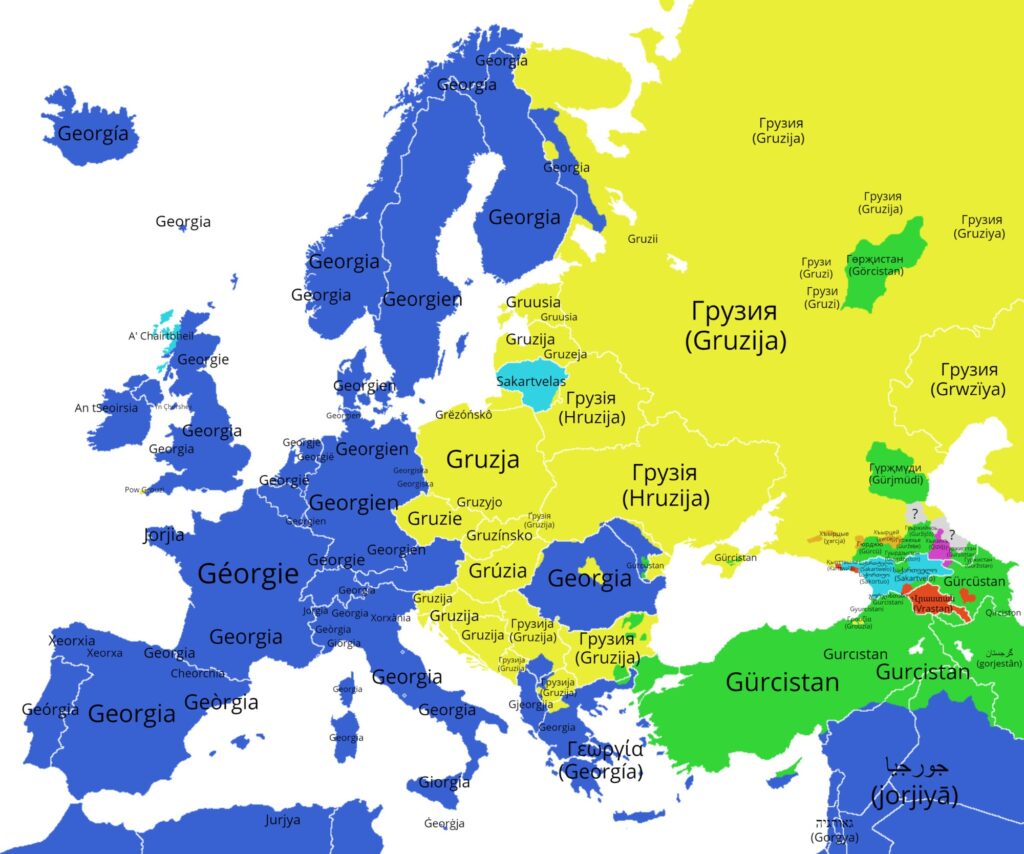
Los nombres de Georgia en las lenguas de Europa, por colores según la etimología.